Vehicle Automotive Digital Multimeter Explained: A UK Buyer's Guide
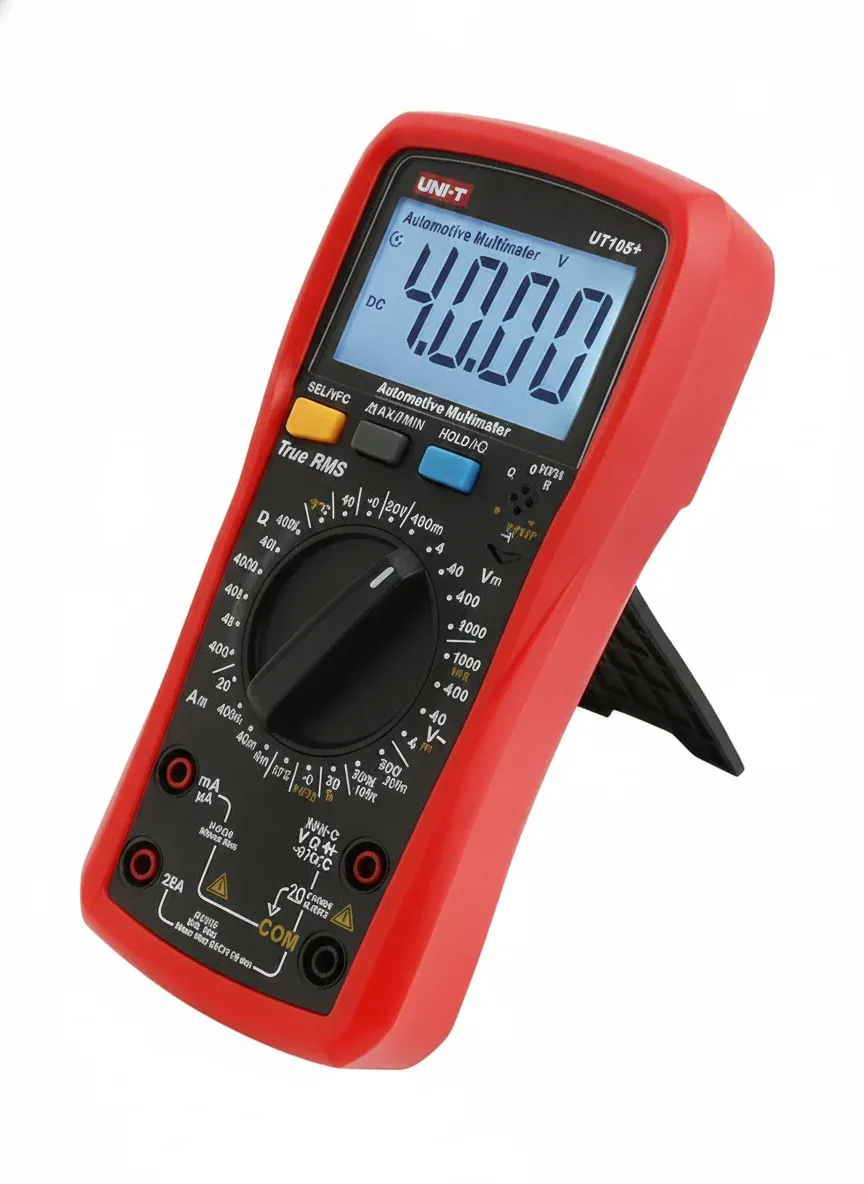
Short answer: a vehicle automotive digital multimeter is a meter set up for the specific jobs a car throws at you — low-resistance readings on ignition and earth paths, continuity on tired looms, sensor signals and temperature — rather than the mains-oriented checks a household meter is built for. If you are tracing electrical gremlins on an older or classic vehicle, that specialisation is what stops you guessing.
Restore an older British car and you know the enemy: decades-old wiring where the colours have faded, connectors that have quietly oxidised, and intermittent faults that come and go with the weather. Working through that by eye is hopeless; a meter that resolves small resistance differences lets you confirm a fault instead of replacing parts on a hunch.
Key things to know about a vehicle automotive digital multimeter
- A vehicle-specific meter is tuned for automotive tasks: continuity on old wiring, low ohms on coils and earth straps, sensor voltages and temperature.
- Probe a sensor circuit without changing what that circuit is doing.
- Good resolution on the ohms range is what lets you compare readings and stop swapping parts on guesswork.
- A manual range is genuinely useful on unstable old circuits where the reading would otherwise keep jumping around.
What is the difference between a standard and an automotive multimeter?
A general-purpose meter is designed with mains and household electrics in mind. An automotive meter keeps the same core measurements but is set up for low-voltage DC vehicle work: it reads cleanly at 12 V and 24 V, resolves small resistances that matter on coils and earths, and often adds temperature via a thermocouple. Crucially, a good automotive meter can sit across a sensitive sensor circuit without changing what that circuit is doing.
What can you diagnose with a vehicle automotive multimeter?
On an older or classic vehicle, the everyday jobs are:
- Continuity on old wiring — tracing a break in a faded loom section by section with an audible beep, rather than trusting the insulation colour.
- Ignition coil resistance — comparing primary and secondary readings against a known-good value, where small differences decide whether a coil is worth replacing.
- Earth straps and bonding — a corroded earth strap adds resistance and mimics all sorts of faults; a low-ohms reading finds it fast.
- Sensors and switches — checking a reference voltage or a switch contact without loading the circuit.
- Temperature — using the K-type probe to sanity-check a thermostat or a running temperature.
Because so many classic-car faults are really charging or earthing problems in disguise, it is worth pairing this with our how to test an alternator with a multimeter guide.
Why you should not load a sensor circuit
Older cars increasingly carry electronic ignition and add-on modules, and modern classics have full ECUs. A low-impedance meter can draw enough current through a sensitive circuit to skew the reading or upset the module. The UNI-T UT107+ is a True RMS automotive multimeter: turn the rotary switch to the function and the range you need. For distorted or switching signals, True RMS is covered in our True RMS automotive digital multimeter guide.
When a manual range is easier to read
On a flaky old circuit the value can jump around. The UNI-T UT107+ is a manual-range meter: turn the rotary switch to the function and the range you need, and the display stays in that window while you watch an intermittent fault on original wiring. How other meters pick a range is covered in our choosing ranges guide.
The AutoTrue UT107+ as a vehicle automotive digital multimeter
The UNI-T UT107+ is a True RMS automotive multimeter for conventional and hybrid vehicle work. It is a 6000-count manual-range meter: turn the rotary switch to the function and the range you need. Safety rating is CAT II 1000 V / CAT III 600 V, CE. It measures DC and AC voltage to 1000 V, current from 6 mA to 10 A (20 A for 10 seconds maximum), RPM, dwell, 12 V battery test, pulse width and capacitance. In the box: English manual, test leads, two AAA batteries, a K-type temperature probe, gift box and carrying bag. £57.29 inc. VAT with free UK tracked delivery.
Frequently asked questions
What is the difference between a standard and an automotive multimeter?
A standard meter is designed with mains and household electrics in mind, while an automotive meter is set up for low-voltage DC vehicle work: clean readings at 12V and 24V, good resolution on the small resistances found on coils and earths, and often a temperature probe.
Can an automotive multimeter test old or classic car wiring?
Yes. Continuity mode traces breaks in a faded loom section by section with an audible beep, and the resistance range checks ignition coils and earth straps. On unstable old circuits, being able to lock the range manually makes the reading easier to follow.
How do you measure ignition coil resistance with a multimeter?
Set the meter to the ohms range, isolate the coil, and measure across the primary and then the secondary terminals, comparing the readings against the coil's known-good values. Good low-ohms resolution matters here because small differences decide whether the coil is worth replacing.
Why should you not load a sensor circuit?
The UNI-T UT107+ is a True RMS automotive multimeter with a 6000-count display. Turn the rotary switch to the function and the range you need, then read voltage, resistance or current on the display.