The Ultimate Guide to Automotive Digital Multimeters in the UK
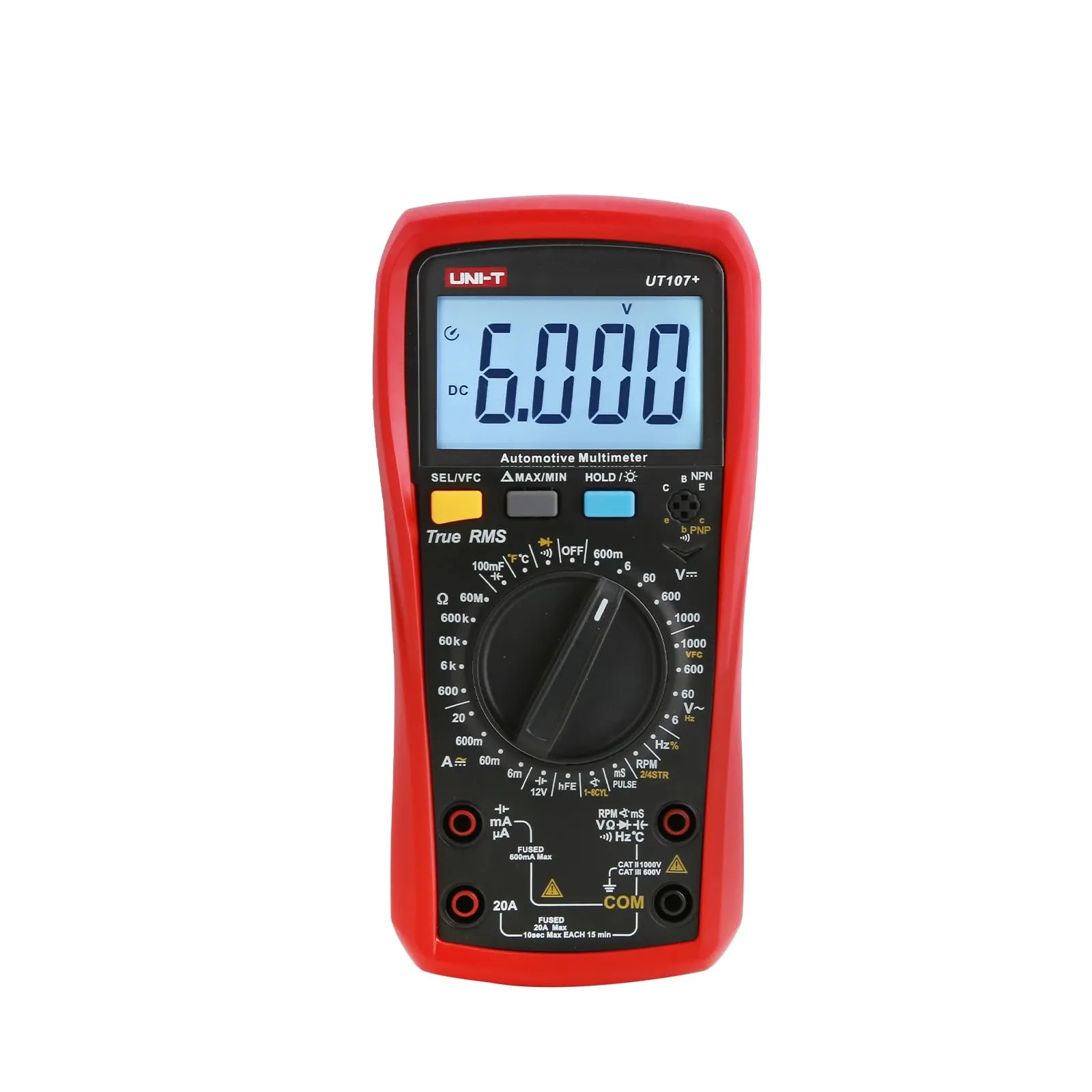
Short answer: an automotive digital multimeter is a meter set up for vehicle electrics — measuring voltage, resistance, continuity, current and often temperature on 12 V and 24 V systems. If you are learning the trade, one good meter takes you from your first battery-voltage check all the way to sensor and temperature diagnosis, without needing to upgrade in six months.
Time on the tools is the thing an apprentice never has enough of. When the college or workshop meters are shared out, your hands-on time gets squeezed, and a general household meter is not labelled for the 12 V and 24 V jobs you actually need to practise. Owning the right meter means you can practise properly, on your own kit, between sessions.
Key takeaways
- An automotive digital multimeter measures voltage, resistance, continuity, current and temperature on vehicle systems.
- The features that matter are True RMS, a clear rotary range switch, a 10 A current range and a proper safety rating.
- One meter can cover 12 V and 24 V vehicles, so you learn on cars, vans and heavier vehicles alike.
- You do not need a 300-to-400-pound flagship to learn on — a well-specified meter around 57 pounds does the job.
What is a digital automotive multimeter?
It is the core electrical tool for vehicle work: a handheld meter that reads DC and AC voltage, resistance and continuity, current, and — with a thermocouple — temperature. What makes it “automotive” is the tuning: reliable readings at 12 V and 24 V, and resolution on the small resistances that matter on cars.
What should you look for in an automotive digital multimeter?
Five things separate a meter you will keep from one you will outgrow:
- True RMS for accurate readings on the pulse-width-modulated signals modern cars are full of — see our True RMS automotive digital multimeter guide.
- Manual range on the rotary switch, so you pick the function and the range you need — see our auto-ranging automotive digital multimeter guide.
- A 6000-count display so small changes on 12 V and 24 V circuits are easy to read.
- A 10 A current range (with 6 mA / 60 mA / 600 mA steps) for current and parasitic-drain work.
- A real safety rating — CAT II 1000 V / CAT III 600 V, CE marked, with insulated leads a tutor will be happy to see.
Why is True RMS important on an automotive multimeter?
Because most vehicle circuits are not clean sine waves. Injectors, pumps, fans and alternators produce switched or rippled signals, and only a True RMS meter reads their true value. Learning on a True RMS meter means the numbers you record are the numbers a professional would trust.
Can you use an automotive multimeter on both 12V and 24V vehicles?
Yes — a proper automotive meter such as the UT107+ is built for both, so the same tool covers a supermini, a van and a 24 V truck or bus. That range is part of why one meter can see you through an apprenticeship and into your first job.
How do you use an automotive digital multimeter for common faults?
The three checks you will run most often are:
- Battery health — resting and charging voltage; the full method is in our how to test a car battery with a multimeter guide.
- Charging system — alternator output and ripple; see how to test an alternator with a multimeter.
- Circuits and sensors — continuity, resistance and reference voltages, including on older wiring, covered in our vehicle automotive digital multimeter guide.
Start with those, get confident, and the rest of the trade's electrical work builds on the same handful of skills.
The AutoTrue UT107+ as a first automotive digital multimeter
The UNI-T UT107+ is a True RMS automotive multimeter for conventional and hybrid vehicle work. It is a 6000-count manual-range meter: turn the rotary switch to the function and the range you need. Safety rating is CAT II 1000 V / CAT III 600 V, CE. It measures DC and AC voltage to 1000 V, current from 6 mA to 10 A (20 A for 10 seconds maximum), RPM, dwell, 12 V battery test, pulse width and capacitance. In the box: English manual, test leads, two AAA batteries, a K-type temperature probe, gift box and carrying bag. £57.29 inc. VAT with free UK tracked delivery.
Frequently asked questions
What is an automotive digital multimeter used for?
It is used to measure voltage, resistance, continuity and current on vehicle electrics, and with a thermocouple it can read temperature too. Typical jobs include battery and charging checks, tracing circuits and continuity, and testing sensors on 12V and 24V systems.
What should an apprentice look for in a first automotive multimeter?
Look for True RMS, a 6000-count display, a 10 A current range and a CAT II 1000 V / CAT III 600 V safety rating with CE marking and insulated leads. Those features let one meter carry you from basic checks to sensor work without needing an upgrade.
Can you use one automotive multimeter on both 12V and 24V vehicles?
Yes. A proper automotive meter such as the UT107+ is built for both 12V and 24V systems, so the same tool covers cars, vans and heavier 24V vehicles.
Is a cheaper automotive multimeter good enough to learn on?
A well-specified meter around 57 pounds is more than enough to learn on and to take into a first job, provided it has True RMS and a CAT II 1000 V / CAT III 600 V safety rating. You do not need a 300-to-400-pound flagship to build the core skills.