Automotive Multimeter Safety: CAT Ratings and Test Leads
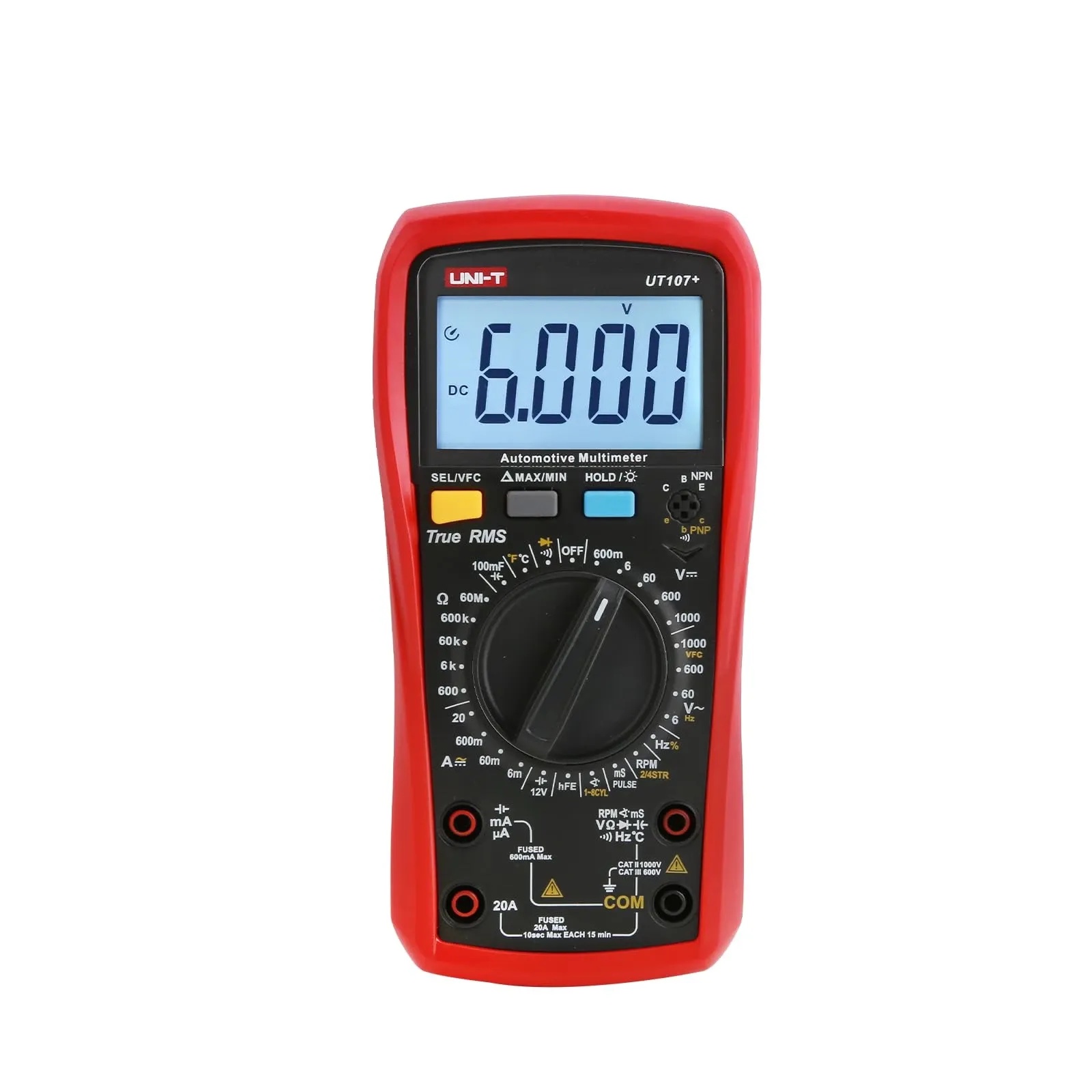
Short answer: A CAT rating is one part of the safety picture, not the whole job. Read the meter’s manual, inspect the leads and finger guards, match the probe rating to the meter, put the red lead in the right jack, and choose the function before you touch the circuit.
The UNI-T UT107+ sold here is rated CAT II 1000 V / CAT III 600 V and carries CE marking. Treat the meter, the leads and the circuit as one system. A printed category on the case does not make every measurement safe.
What a CAT rating actually tells you
Category ratings describe the kind of electrical environment the instrument is designed for. They are not a league table where a bigger printed number is always the safer choice for every job. CAT II covers circuits closer to the load. CAT III covers distribution-level work such as a consumer unit. Workshop vehicle jobs sit on 12 V and 24 V systems, but mains is still nearby, and a meter can be asked to read more than battery voltage.
Use the rating on the UT107+ as the ceiling for this meter, then take the lower of the meter rating and the lead rating.
Check the meter and the leads together
| Element | Must agree | Common mistake |
|---|---|---|
| Meter | Manual, category, voltage and fuse information | Trusting front printing without the manual |
| Leads | Equal or suitable rating; intact guards and insulation | Using damaged or low-rated replacements |
| Jack | Matches voltage/resistance or current work | Leaving the red lead in a current input |
| Circuit | Expected voltage and energy understood | Treating a low nominal voltage as zero hazard |
Set up before you take a reading
- Identify the circuit, the expected voltage and the energy that could be present.
- Read the current UNI-T manual for this meter.
- Inspect the case, input jacks, fuses, probes, insulation and finger guards.
- Use the lower rating of the meter, the leads and any accessory.
- Black lead in COM. For voltage, resistance, frequency, temperature, RPM and dwell, red lead in the VΩ jack. For the 12 V battery test on the UT107+, red lead in the mA jack. For high current, red lead in the 20 A jack (20 A for 10 seconds maximum).
- Turn the rotary switch to the function and the range you need before the probes touch the circuit.
- When you finish, remove the leads, put the current-jack lead away, and write down the reading.
Mistakes that hurt
- Measuring voltage with the lead still in a current jack.
- Assuming a higher printed CAT number is automatically safer for every task.
- Using probes with cracked insulation.
- Holding beyond the finger guards.
- Measuring resistance on a live circuit.
Related workshop guides
Pair this with how to test a car battery, how to test an alternator, and the UNI-T UT107+ product page when you want the meter itself.
Frequently asked questions
What CAT rating does the UT107+ have?
CAT II 1000 V / CAT III 600 V, with CE marking. Current on the 20 A jack is 10 A continuous, 20 A for 10 seconds maximum. Dual fuse inside.
Does a higher CAT number always mean safer?
No. The rating has to match the circuit you are on, and the leads have to match the meter. A higher printed category is not automatically the right choice for every job.
Where should the red lead go?
Voltage, resistance, frequency, temperature, RPM and dwell use the VΩ jack. The 12 V battery test on this meter uses the mA jack. High current uses the 20 A jack, 10 seconds maximum. Black stays in COM.
What should I inspect on the leads?
Insulation, finger guards, and the rating printed on the leads. Damaged or under-rated leads bring the whole setup down to their limit, whatever the meter says on the case.